
 By Henry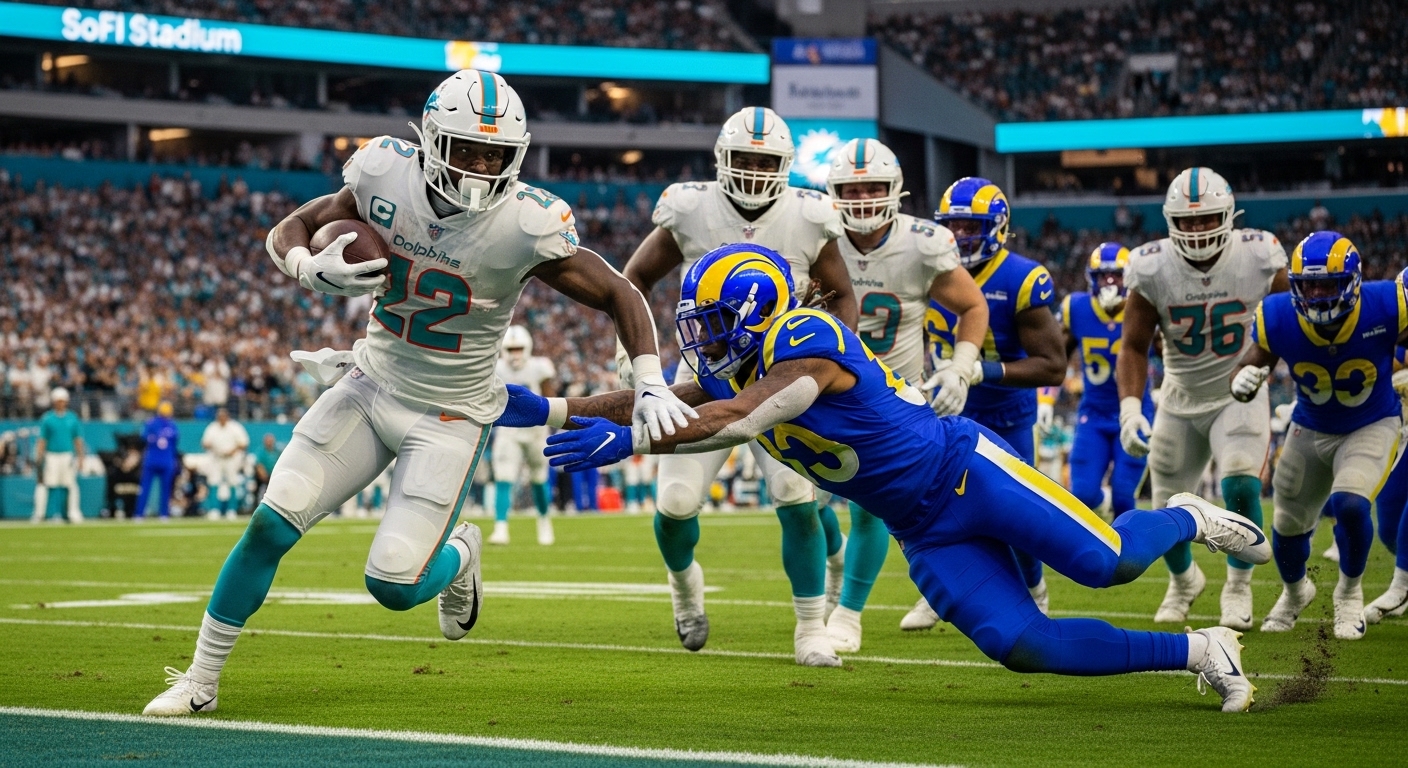
Picture this: under the bright lights of Monday Night Football, two teams desperate for a spark collide at SoFi Stadium. The Miami Dolphins, reeling from a three-game skid, face off against a resurgent Los Angeles Rams squad fresh off three straight wins. What unfolds is a gritty, defense-dominated affair where the miami dolphins vs los angeles rams match player stats tell a tale of resilience, missed opportunities, and clutch plays. Miami emerges victorious 23-15, snapping their losing streak and keeping faint playoff hopes alive, while the Rams stumble back into uncertainty.
This clash, attended by 72,474 fans, wasn’t a high-scoring shootout but a chess match defined by field goals, turnovers, and timely stops. Let’s break it down, weaving the hard numbers with the game’s pulse to show why the Dolphins prevailed.
The Dolphins jumped out early and never trailed, building a lead through efficient drives and a stingy defense that held the Rams out of the end zone entirely. All 15 of Los Angeles’ points came from rookie kicker Joshua Karty’s foot, marking just the second time in four years the Rams failed to score an offensive touchdown with Matthew Stafford under center. Miami, meanwhile, mixed two touchdowns with three field goals from Jason Sanders, capitalizing on short fields and red zone chances.
Team stats paint a picture of balance for Miami and inefficiency for Los Angeles. The Dolphins totaled 274 yards (207 passing, 67 rushing), converted 6 of 13 third downs (46%), and went 2-for-3 in the red zone (67% efficiency). The Rams edged them in total yards with 363 (293 passing, 70 rushing) but struggled mightily on third downs (2-for-11, 18%) and went 0-for-3 in the red zone, settling for field goals each time. Turnovers played a role too: both teams had one interception, but Miami recovered a fumble while Los Angeles lost one, shifting momentum at key moments.
Here’s a quick comparison table of team totals:
| Category | Miami Dolphins | Los Angeles Rams |
|---|---|---|
| Total Yards | 274 | 363 |
| Passing Yards | 207 | 293 |
| Rushing Yards | 67 | 70 |
| Third Down Conversion | 6/13 (46%) | 2/11 (18%) |
| Red Zone Efficiency | 2/3 (67%) | 0/3 (0%) |
| Turnovers | 2 (1 INT, 1 FUM) | 2 (1 INT, 1 FUM lost) |
| Sacks | 4 | 3 |
| Time of Possession | 27:11 | 32:49 |
This disparity in efficiency, especially in critical areas, explains why Miami controlled the game’s flow despite being outgained.
The spotlight shone on the signal-callers, with Tua Tagovailoa and Matthew Stafford delivering contrasting performances in this head-to-head matchup. Tagovailoa, back from a concussion earlier in the season, looked sharp and composed, completing 20 of 28 passes (71.4%) for 207 yards, one touchdown, and one interception. His 89.4 passer rating reflected poise under pressure, particularly on third downs where he went 9-for-12 for 137 yards, keeping drives alive. Stafford, on the other hand, threw for more volume: 32 of 46 (69.6%) for 293 yards, no touchdowns, and one pick, earning a 77.5 rating. He faced constant harassment from Miami’s pass rush, taking four sacks for 36 yards lost.
In their first direct clash since 2020 (when Tagovailoa was a rookie and Stafford was with Detroit), Tagovailoa outdueled the veteran by making fewer mistakes and delivering in crunch time. Think of it like a boxer landing precise jabs while the opponent swings wildly: Stafford’s yards came mostly on underneath routes, but without red zone success, they amounted to little. Tagovailoa’s key throw? A third-quarter dart to Tyreek Hill for a one-yard touchdown, ending Hill’s scoring drought and pushing the lead to 17-6.
Neither team dominated on the ground, but Miami’s 67 yards on 22 carries (3.0 average) included a game-changing 18-yard touchdown scamper by rookie Malik Washington, his first NFL score, on the opening drive. De’Von Achane led the Dolphins with 12 carries for 37 yards (3.1 average), adding versatility with five receptions for 15 yards. His 15-yard run was the longest for Miami, but the unit as a whole leaned on short gains to control the clock.
For the Rams, Kyren Williams managed 62 yards on 15 attempts (4.1 average), but a costly fumble in the second quarter stalled momentum. Blake Corum chipped in eight yards on two carries, yet Los Angeles couldn’t establish rhythm against Miami’s front seven. Overall, the rushing stats highlight a defensive battle where big plays were scarce, forcing both offenses to rely on passing.
Tyreek Hill, battling a torn wrist ligament aggravated during a pre-season police incident, still made his mark with three catches for 16 yards and that crucial touchdown. He played through pain, focusing on short routes and even adding 11 rushing yards on two end-arounds. Jaylen Waddle paced Miami with three receptions for 57 yards, including a 36-yard bomb that set up a field goal. Tight end Jonnu Smith contributed 45 yards on three grabs, while Achane’s five catches underscored his dual-threat role.
On the Rams’ side, Puka Nacua exploded for nine receptions and 98 yards, leading all receivers and proving his second-year prowess. Cooper Kupp added seven for 80, but the duo couldn’t find the end zone. Tight end Davis Allen emerged with five catches for 34 yards, stepping up in a lead role. These numbers show how Los Angeles moved the ball between the 20s but faltered closer to paydirt.
The Dolphins’ defensive line was the game’s unsung hero, sacking Stafford four times and generating six quarterback hits. Calais Campbell, Jevon Holland, Quinton Bell, and Chop Robinson each notched a sack, while Zach Sieler added a tackle for loss. Linebacker Jordyn Brooks led with 11 tackles, and Anthony Walker Jr. grabbed an interception. Rookie edge rusher Jared Verse made an impact for the Rams with four tackles, one sack, and two tackles for loss, showcasing his disruptive potential. But Miami’s unit as a whole forced the Rams into five field goals, including stops at the 4-yard line.
Defensive box score highlights:
| Team | Tackles | Sacks | INT | PD | QB Hits |
|---|---|---|---|---|---|
| Dolphins | 71 | 4 | 1 | 6 | 6 |
| Rams | 57 | 3 | 1 | 4 | 4 |
This pressure cooker environment limited big plays and forced field goals, tilting the outcome.
Joshua Karty was a bright spot for the Rams, drilling five field goals (34, 55, 53, 22, 31 yards), including two from beyond 50, accounting for all their points. He missed one, but his long-range accuracy kept Los Angeles in it. Jason Sanders countered with three makes (37, 50, 25 yards), sealing the win with a 50-yarder late. Punters Jake Bailey and Ethan Evans averaged 44.7 and 49.3 yards respectively, with Evans pinning Miami inside the 20 twice.
For fantasy managers, this game offered mixed bags. Puka Nacua topped scorers with 9 receptions for 98 yards (15.8 PPR points), making him a must-start moving forward. Cooper Kupp followed with 7/80 (15 PPR), solid but touchdown-less. On Miami’s side, Tyreek Hill’s 3/16/1 TD (10.6 PPR) ended his drought but underwhelmed volume-wise due to his wrist. De’Von Achane posted modest 37 rushing yards but added 15 receiving (9.2 PPR), securing his lead-back status. Raheem Mostert, limited to third downs, is droppable in redrafts. Quarterbacks disappointed: Tagovailoa (11.98 points) and Stafford (9.72) lacked touchdowns. Karty’s 15 points (if your league scores long FGs bonus) made him a streamer hero.
Fantasy points leaders table (standard PPR scoring approximation):
| Player | Team | Fantasy Points (PPR) | Key Stats |
|---|---|---|---|
| Puka Nacua | Rams | 18.8 | 9 rec, 98 yds |
| Cooper Kupp | Rams | 15.0 | 7 rec, 80 yds |
| Joshua Karty | Rams | 15.0 | 5 FG |
| Tyreek Hill | Dolphins | 10.6 | 3 rec, 16 yds, 1 TD |
| De’Von Achane | Dolphins | 9.2 | 37 rush, 15 rec |
| Jaylen Waddle | Dolphins | 8.7 | 3 rec, 57 yds |
Managers should monitor Hill’s wrist for future weeks; it limited his deep targets.
Miami’s victory boiled down to defense and opportunism. Key turning points included Washington’s opening touchdown run, setting an aggressive tone; Hill’s third-quarter score, extending the lead after a Rams three-and-out; and a fourth-quarter fumble recovery by Kendall Fuller, leading to a field goal. The Rams’ red zone woes, going 0-for-3, loomed large: they reached Miami’s 4-yard line but settled for three points. Verse’s rookie impact was felt with his sack, but Miami’s line overwhelmed overall.
In a broader sense, this game exposed the Rams’ regression after scoring 76 points in their prior three wins, while Miami’s grit in primetime (their second win in eight games) provided a blueprint for turnaround. For fans and fantasy folks, it’s a reminder that stats alone don’t win; execution in high-leverage spots does.
As we wrap up this deep dive into the miami dolphins vs los angeles rams match player stats, remember: football’s beauty lies in these nuances, where a single sack or field goal flips the script.
- Revisit your fantasy lineup: Prioritize Achane as a flex play, but fade Mostert.
- Watch injury reports: Hill’s wrist could linger, impacting deep threats.
- Dive into advanced metrics: Check PFF grades for Verse (strong run defense) and Campbell (pass rush elite).
- Stream kickers wisely: Karty’s leg makes him viable against weak defenses.
- Engage with the community: Share your takes on social media or forums.
What did you think of the game? Share your experience below!
You May Also Like: Who Won the War in the Trenches? Green Bay Packers vs Philadelphia Eagles Match Player Stats Revealed
What were Tua Tagovailoa’s passing yards in the game?
Tagovailoa threw for 207 yards on 20-of-28 completions, with one touchdown and one interception.
How many field goals did Joshua Karty make?
Karty connected on five of six field goals, including longs of 55 and 53 yards, scoring all 15 Rams points.
What was Tyreek Hill’s wrist injury status?
Hill played through a torn ligament in his wrist, aggravated earlier in the season, and scored a touchdown despite limited production.
Who led the Rams in receiving yards?
Puka Nacua topped the list with 98 yards on nine receptions.
What was the red zone efficiency for both teams?
Miami converted 2 of 3 red zone trips (67%), while Los Angeles went 0 for 3 (0%).
How did Jared Verse impact the game as a rookie?
Verse recorded four tackles, one sack, and two tackles for loss, disrupting Miami’s offense.
What was the attendance at SoFi Stadium?
72,474 fans attended the Monday Night Football matchup.